
You picked a payment processor. Good. Now a customer emails asking why their subscription paused.
You open Gmail, flip to Stripe or Lemon Squeezy, track down the customer, check their status, draft a reply, go back to email, hit send. Seven minutes gone. One ticket.
Thirty tickets a day means three and a half hours of that.
Most comparisons between these two platforms stop at fees and payout speed. This one doesn’t. If you’re handling support yourself, or with one part-time hire, the support integration story matters just as much as the transaction rate.
Here’s how they actually stack up.
Why Support Integration Matters When Choosing a Payment Tool
Fees, payout speed, merchant-of-record status — those are the usual comparison points, and they’re worth knowing.
But for a solo founder or a small team doing support personally, there’s another question worth asking: how many steps does it take to resolve a ticket?
Every email about a failed charge, a paused subscription, or a billing question requires pulling customer data fast. The payment platform you use determines how buried that data is.
Three menus deep costs you time on every single ticket, every single day.
Lemon Squeezy vs Stripe: A Quick Overview
| Lemon Squeezy | Stripe | |
|---|---|---|
| Type | Merchant of Record (MoR) | Payment processor |
| Tax handling | Automatic (global sales tax, VAT) | Manual or via third-party |
| Pricing | 5% + $0.50 per transaction | 2.9% + $0.30 per transaction |
| Best for | Indie founders, digital products | SaaS with custom billing logic |
| API depth | Growing, solid for basics | Extremely deep and flexible |
| Support data access | Customer portal, basic API | Full API, webhooks, dashboard |
| Setup complexity | Low | Medium to high |
Lemon Squeezy acts as the merchant of record — it handles VAT, sales tax, and compliance on your behalf.
Stripe doesn’t.
For a solo founder selling globally, that distinction alone can settle the debate. From a support workflow angle, though, the picture gets more complicated.
How Each Platform Handles Support Workflows
Lemon Squeezy and Support
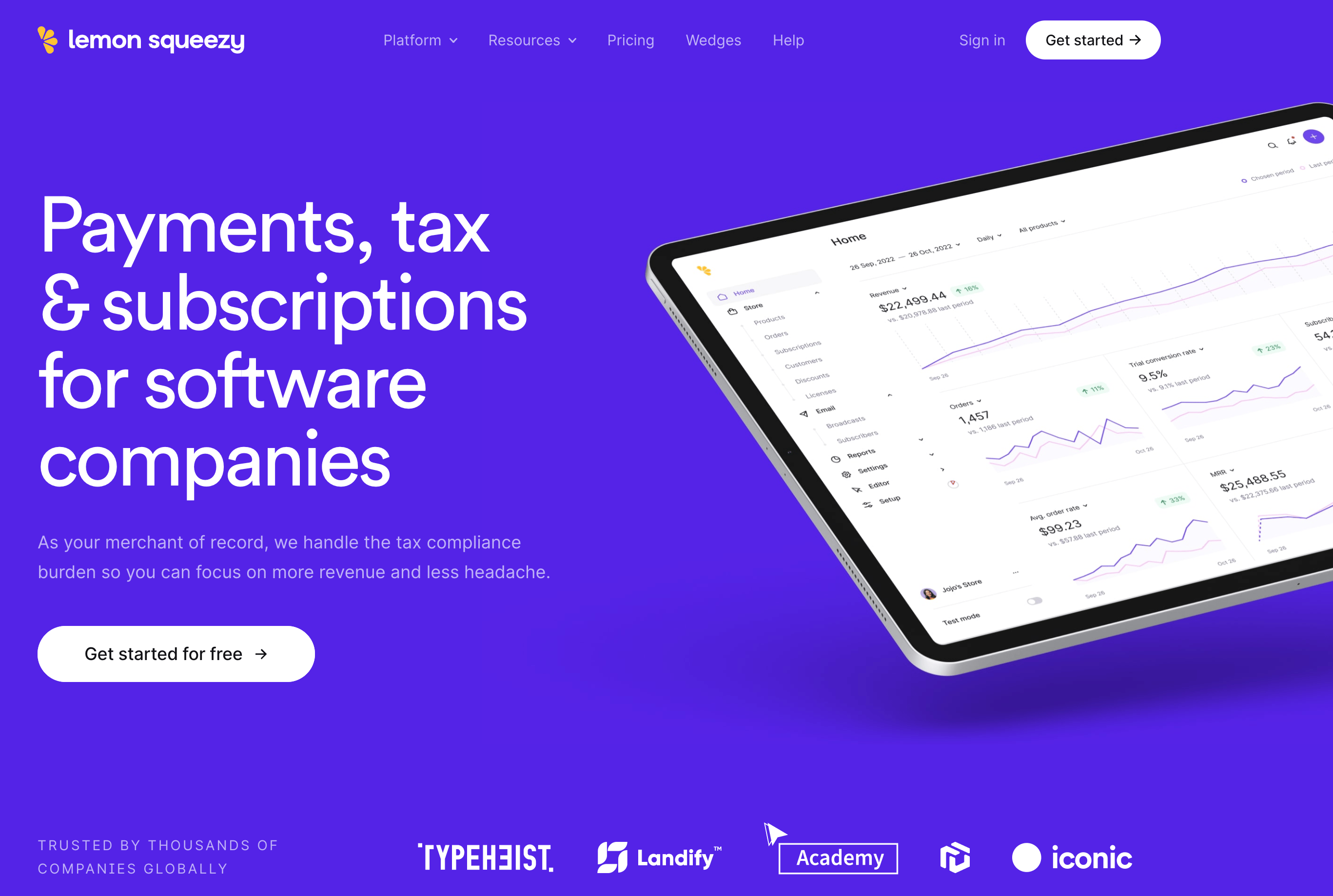
Lemon Squeezy gives customers a self-service portal where they can manage subscriptions, download invoices, and update payment methods. That trims some inbound volume before it ever reaches your inbox.
When tickets do come in, you can look up customers by email in the dashboard and handle refunds, pauses, and cancellations from the admin panel. The API covers most of these actions programmatically.
What Lemon Squeezy doesn’t give you is a native support inbox. Email still lives somewhere else.
The workflow is: read the email in Gmail, open Lemon Squeezy in another tab, find the customer, take action, go back to email, reply. Every time.
The API is solid enough to build on, but you still need to bridge the gap between your inbox and the payment data yourself.
Stripe and Support

Stripe’s API is one of the most complete in payments. Customers, subscriptions, invoices, charges, disputes — you can query all of it programmatically.
Webhooks fire on nearly every event. If you want to build a custom support layer on top of Stripe data, the raw material is there.
The dashboard itself is powerful but not built for support speed. Finding a customer, checking their subscription status, and issuing a refund still takes multiple clicks.
It wasn’t designed for someone moving through 50 tickets a day.
And like Lemon Squeezy, Stripe has no native support inbox. The payment data lives in one place, your email lives somewhere else, and you’re the one bridging the gap by hand.
Side-by-Side Comparison: Support Integration in 2026
| Feature | Lemon Squeezy | Stripe |
|---|---|---|
| Customer self-service portal | Yes | Limited (via Billing Portal) |
| Refund from dashboard | Yes | Yes |
| Subscription pause from dashboard | Yes | Yes (with config) |
| API for support actions | Yes | Yes, more extensive |
| Native support inbox | No | No |
| Webhook events for support triggers | Yes | Yes, more granular |
| Tax/compliance handled | Yes (MoR) | No |
| Third-party support tool integrations | Growing | Extensive |
| Setup complexity for support workflows | Low | Medium |
Both platforms give you the building blocks. Neither gives you a finished support workflow. Something still needs to sit between your inbox and the payment data.
The Real Problem: Neither Solves the Tab-Switching Loop
Here’s the honest answer: Lemon Squeezy and Stripe are payment tools. They’re not support tools. Expecting either one to fix your support workflow is the wrong frame.
The actual pain looks like this: open email, hunt the customer in Stripe or Lemon Squeezy, check subscription status, draft a reply, switch back, send. Repeat 50 times a day. That loop costs roughly 7 minutes per ticket. At 30 tickets a day, that’s 3.5 hours of pure context-switching.
Neither platform eliminates that loop on its own.
What eliminates it is a layer that reads the email, pulls the payment data automatically, and puts the right action one click away.
How Zipitly Connects Both Platforms to Your Support Inbox
Zipitly integrates directly with both Stripe and Lemon Squeezy. When a support email arrives, Zipitly reads the intent, pulls the relevant customer data from whichever payment tool you use, drafts a reply, and surfaces the right action — refund, pause, cancel, credit — without you opening a second tab.
AI suggests. You approve. Done in under 2 minutes per ticket, down from 7.
A few things worth knowing:
- Setup takes under 60 seconds. One DNS TXT record gives you a real support@yourcompany.com address. No Google Workspace subscription required.
- You stay in control. Nothing sends or executes without your explicit approval. Edit the draft, override the action, or switch to manual at any time.
- No per-seat pricing. Zendesk charges $19 to $115 per agent per month. Zipitly doesn’t use that model.
- No knowledge base. Zipitly is purely the AI layer that lives inside the email your customers already send.
Whether you’re on Lemon Squeezy or Stripe, the workflow collapses from seven steps to one. Zipitly is currently waitlist-only. You can join at zipitly.com.
Which Should You Choose?
Choose Lemon Squeezy if:
- You sell digital products or SaaS globally and want tax compliance handled automatically
- You’re an indie founder who wants low setup friction
- You don’t want to think about VAT or sales tax
- Your billing logic is straightforward
Choose Stripe if:
- You need deep, custom billing logic — usage-based, tiered, complex trials
- You have developer resources to build on top of the API
- Lemon Squeezy’s transaction fees are a meaningful cost at your volume
- You need the widest range of third-party integrations
For support workflow, the answer is the same either way. Both tools leave you with a tab-switching problem. The fix isn’t which payment processor you pick — it’s what you put in front of your inbox.
Conclusion
Lemon Squeezy wins on tax simplicity and low setup friction.
Stripe wins on API depth and billing flexibility.
For most indie founders and small SaaS teams, the choice comes down to whether you want compliance handled for you or maximum control over billing logic.
What neither platform solves is the support workflow itself. That seven-minute-per-ticket loop exists regardless of which one you pick. Closing it requires something that sits between your inbox and your payment data — and actually connects the two.
If that problem sounds familiar, take a look at Zipitly and join the waitlist.